
Regulating the Financial System and the Real Economy Symposia
Organised and hosted by the Centre for Responsible Banking & Finance, and Department of Finance at the University of St Andrews Business School, the Regulating the Financial System and the Real Economy symposia seek to advance scholarly and policy-relevant understanding of how economic and financial regulation shapes the financial system and the real economy.
The symposia encourage sustained dialogue between academic researchers, policymakers and practitioners in order to improve mutual understanding and generate insights that inform the design of robust regulatory policies that promote a safe and sound financial system and dynamic, innovative and resilient real economy.
Previous symposia
Topics in Sustainable Finance Symposium – 18 March 2026
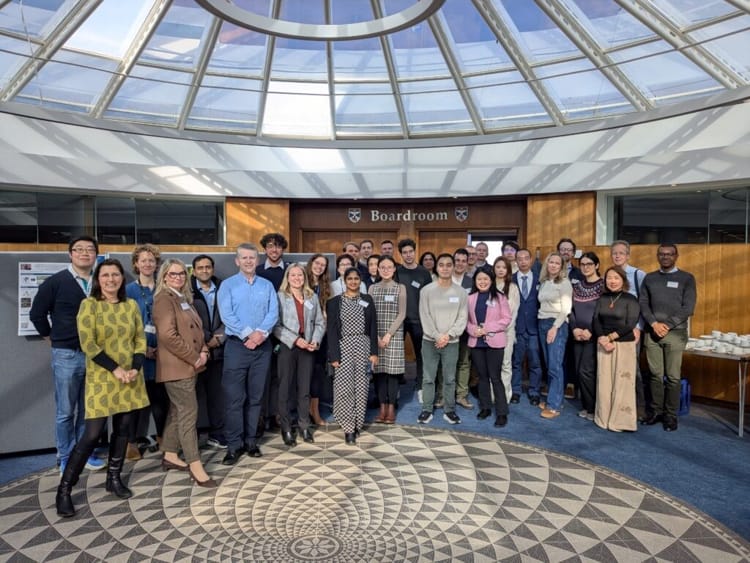
The Finance Department at the University of St Andrews Business School and Centre for Responsible Banking and Finance (CRBF), in collaboration with Scotland Beyond Net Zero and with support from the St Andrews Centre for Critical Sustainabilities, hosted its Sustainable Finance Symposium on 18 March 2026 as part of the University’s Sustainability Week.
The symposium brought together academics and practitioners from across the UK and Europe to examine whether the rapid rise of sustainable finance is translating into meaningful change. Ralph De Haas (European Bank for Reconstruction and Development) opened the day with a keynote on how banks are navigating climate commitments in emerging markets, setting the tone for a day focused on the gap between ambition and delivery. In his talk he outlined evidence that banks signing international climate initiatives do follow through with stronger green lending practices, and that their borrowers are in turn more likely to undertake green investments.
Research presentations explored how firms respond to biodiversity transition risk, with evidence that firms cut jobs in areas exposed to future land-use restrictions while reallocating labour toward green occupations (Huyen Nguyen, King’s College London); how the floods reshape credit pricing, as banks reduce rates for firms that adapt through insurance and local climate protection measures, shifting the burden of disaster risk towards insurance companies rather than banks (Oliver Rehbein, WU Vienna); and how political context shapes sustainable investment decisions, with evidence that when government is perceived as less likely to regulate, some investors increase their green allocations to privately offset policy shortcomings (Stefano Ramelli, University of St Gallen). A consistent theme emerged: while frameworks and commitments have expanded rapidly, understanding and managing these complex risks in practice remains a significant challenge.
The afternoon featured a poster session showcasing work by early-career researchers from across Scottish and UK institutions, followed by a policy panel — “Making Sustainable Finance Work in Practice: A Scottish Perspective” — moderated by Dimitris Andriosopoulos (University of Strathclyde), with panellists Di Luo (University of Dundee), Stefanie O’Gorman (Ramboll), Simon Thompson, and Claire Wallace-Jones (Barclays UK). The discussion highlighted that sustainable finance is not retreating — rather, the bar for what counts as genuine transition finance has risen. Panellists noted that Scotland’s challenge is not a lack of capital (Edinburgh ranks 18th globally in green finance) but coordination: connecting that capital to investible projects in areas such as grid infrastructure, place-based investment, and nature financing. The panel also stressed that re-skilling the workforce is as important as mobilising capital, and that finance and education policy must move together.
The symposium was organised by Dr Eleonora Sfrappini (Lecturer in Finance) with support from Dr Maria Chiara Iannino and Dr Karishma Ansaram from Scotland Beyond Net Zero.
Topics in Financial Regulation Symposium – 29 April 2025

The CRBF hosted the Topics in Financial Regulation Symposium as part of the symposia series, in Spring 2025. This event brought together prominent academics, policymakers and industry practitioners to discuss contemporary challenges in financial regulation. Professor John Wilson opened the event, emphasising the critical role of rigorous, evidence-based regulation in ensuring financial stability and maintaining public trust, while highlighting the symposium as an important platform for knowledge exchange and policy influence.
Presentations covered diverse subjects, including:
- emergency lending and moral hazard – Dr John Kandrac, Federal Reserve Board
- liquidity regulation and bank lending under unconventional monetary policies – Professor Barbara Casu, Bayes Business School
- the distributional impacts of banking regulation in Europe – Dr Melina Ludolph, Halle Institute for Economic Research
- implicit guarantees and bank stability – Dr Anna Lucia Sobiech, University of Cologne
- a critical evaluation of the FCA’s 2019 overdraft policy – David Farmer, Financial Conduct Authority.
Each presentation was enriched by expert commentary from discussants from the Universities of St Andrews and Glasgow. The event, organised by Professor John Wilson, Dr Christian Engels, Sumit Bains, and Kirsty Forbes, reinforced CRBF’s commitment to impactful, policy-oriented financial regulation research.
See more about the April 2025 symposium.
Topics in Economic Regulation Symposium – 2 October 2024
In October 2024, the CRBF hosted the Topics in Economic Regulation Symposium: Digital Markets and Consumer Choice & Behaviour at the University of St Andrews Business School. Bringing together academics, regulators and industry practitioners, the workshop explored how artificial intelligence and other digital technologies are reshaping market dynamics and consumer decision-making. Dr Sapnoti Eswar offered the welcome, and Professor Mark Brewer, Dean of the Business School, delivered the plenary introduction, stressing the need for evidence-based regulation to foster fair, competitive and innovative digital markets.
Across four themed sessions, speakers examined current regulatory challenges. Highlights included:
- the CMA’s initial review of AI foundation model – Abbi Crisswell
- a trading-app experiment on digital engagement practices – Cameron Gilchrist, FCA
- social-media influences on online news – Tom Farrell, Ofcom
- consumer attitudes to digital assets – Colin Higgins, FCA
- Wowcher’s online choice architecture – Helen Ferguson and Abhi Ranasinghe Arachchige, CMA.
Further papers analysed:
- retail-market definition using card-spending data – Samir Doshi, CMA
- price-level data for different household groups – Hannah Randolph, University of Strathclyde
- early gender income gaps among children – Christian Engels, University of St Andrews
- consumer choices on the path to net-zero – Camilla Barnett, Consumer Scotland
- behavioural-economics approaches to online safety – Amy Hume, Ofcom.
The lively exchanges underscored CRBF’s commitment to connecting cutting-edge research with regulatory practice in the digital economy.