
Topics in Sustainable Finance Symposium, 18 March 2026

Topics in Sustainable Finance Symposium
18 March 2026 • 10:00 – 17:00
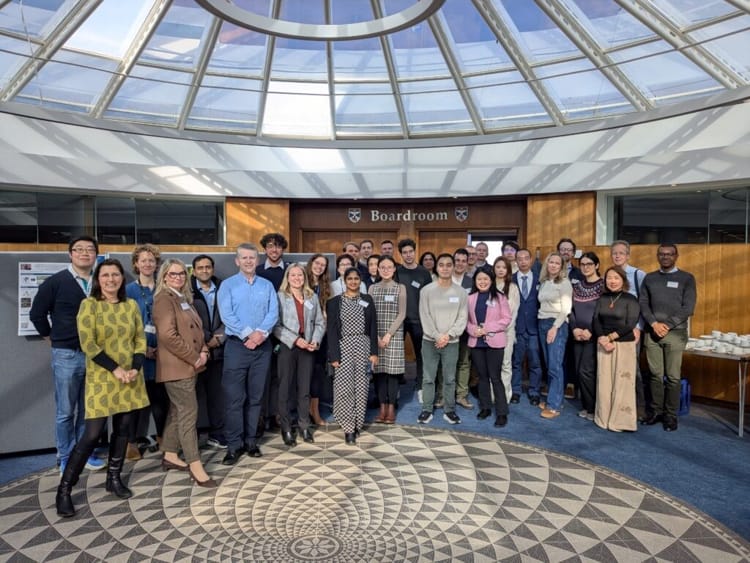
Boardroom, Gateway Building
University of St Andrews
9:30 – 10:00 Registration & Welcome Coffee
10:00 – 10:10 Welcome — Prof. John Wilson, Head of Department of Finance
10:10 – 11:10 KEYNOTE “Walking the Talk? Banks’ Climate Commitments in Emerging Markets and Beyond”
Ralph De Haas, European Bank for Reconstruction and Development
We document how banks’ voluntary climate commitments predict both their green lending practices and their borrowers’ environmental investments. Using structured surveys of 644 bank CEOs and heads of credit across 33 low- and middle-income countries, we develop indices of banks’ green management and lending practices. These unique organisational data reveal that banks signing international climate initiatives (‘talk’) indeed exhibit stronger green practices (‘walk’) than non-signatories. We then merge our bank data with detailed surveys of 4,719 firms and show that firms borrowing from climate-committed banks are more likely to undertake green investments. Exploiting geocoded bank branch and firm locations, we further find evidence of spatial matching: environmentally-oriented firms preferentially borrow from climate-committed banks in their vicinity. These patterns are consistent with voluntary climate commitments reflecting genuine environmental orientation rather than greenwashing.
11:10 – 11:40 Coffee Break
11:40 – 12:25 “Employment Responses to Increased Biodiversity Transition Risk”
Huyen Nguyen, King’s College London
Discussant: Bert Scholtens, University of Groningen / University of St Andrews
This paper examines how firms adjust the number and types of workers they hire in response to increased biodiversity transition risk. Using the adoption of the Key Biodiversity Areas Standard of 2016 as a source of variation that increases the risk of future land-use restrictions, we find that firms reduce job postings in affected areas and reallocate labour to less exposed regions. This effect is concentrated among firms that make negative impacts on biodiversity. Cuts are stronger among production roles, while hiring in green and adaptive occupations increases. The effect is not driven by changes in capital investment or workers’ labour supply decisions. Our findings contribute to the ongoing debate on the costs and benefits of biodiversity conservation policies and their implications for labour market outcomes.
12:25 – 13:30 LUNCH & POSTER SESSION
Poster Presenters:
- Lydia Cole (University of St Andrews) — Exploring Local Foundations for Global Climate Solutions in Scotland’s Peatlands
- Jethro Browell (University of Glasgow) — Quantifying Residential Financed Emissions: Evaluating Data and Modelling Scenarios under the PCAF Framework
- Jaber Islam (University of Edinburgh) — Does Managerial Ability Promote Firm-level Nature Dependence?
- Belle Guo (University of Dundee) — Socially Responsible Investment in Greening Finance: Empirical Insights and Future Directions
- Sandra Belaunde (University of Edinburgh) — Sustainable Finance in Latin America: Actors, Practices, and Coordination in Context
- Xiaotong Sun (University of Glasgow) — Pricing Sustainability or Pricing Illiquidity? Evidence from ESG Index Futures
- Emmanouil Pyrgiotakis (University College Dublin) — The Carbon Footprint of Green Bonds: Evidence from Project-level Data
- Quang Minh Nguyen (University of St Andrews) — Biodiversity Risk in Mutual Funds: Pricing, Flows, and Stress-Testing
13:30 – 14:15 “When the Dam Almost Breaks: Disasters and Credit Risk”
Oliver Rehbein, WU Vienna
Discussant: John Kandrac, Federal Reserve Board
How does risk pricing change in credit markets after observing a nearby catastrophic event? We combine detailed geospatial data on ex-ante flood risk of German firms with credit register data and show that after a major flood in 2021, loan rates decrease for high-flood risk firms that were not directly affected. We provide evidence that this decrease is an endogenous reaction to updated flood-risk information at both banks and firms. Banks decrease their disaster risk exposure by increasing securitisation. They also respond to climate adaptation measures taken by their firms: in regions where local governments invest heavily in climate protection measures after the flood, we observe the largest decreases in interest rates. We also use novel insurance data to show that decreases are strongest when firms purchase additional insurance after the flood.
14:15 – 15:00 “Socially Responsible Investing in the Political Context”
Stefano Ramelli, University of St Gallen
Discussant: Ben Sila, University of Edinburgh
Can changes in political context shift the weight individuals place on non-pecuniary versus pecuniary motives in financial decision-making? We examine this question using pre-registered surveys and incentivised investment decisions surrounding the 2024 U.S. presidential election. Following Trump’s victory, investors reduced average green investments due to worse financial expectations. However, investors who strongly disapproved of his climate policies increased their green allocations, emphasising climate considerations over financial ones. These ‘contrarian’ investors appear motivated to offset perceived policy shortcomings. Real-world ETF flows corroborate this pattern. The findings have implications for understanding and modelling values-based investment behaviour.
15:00 – 15:30 Coffee Break
15:30 – 16:30 POLICY PANEL “Making Sustainable Finance Work in Practice: A Scottish Perspective”
Moderator: Dimitris Andriosopoulos, Professor, University of Strathclyde
Di Luo — Professor, University of Dundee
Stefanie O’Gorman — Director of Sustainable Economics,
Ramboll Simon Thompson — Author, Green & Sustainable Finance: Principles and Practice
Claire Wallace Jones — Head of Climate Risk & Chief of Staff, Barclays UK Risk
16:30 – 17:00 Closing Remarks & Networking
Organised by: Department of Finance, University of St Andrews Business School In collaboration with: Scotland Beyond Net Zero (SBNZ) & Centre for Responsible Banking & Finance (CRBF) With support from: St Andrews Centre for Critical Sustainabilities (StACCS) For enquiries contact Dr Eleonora Sfrappini — [email protected]